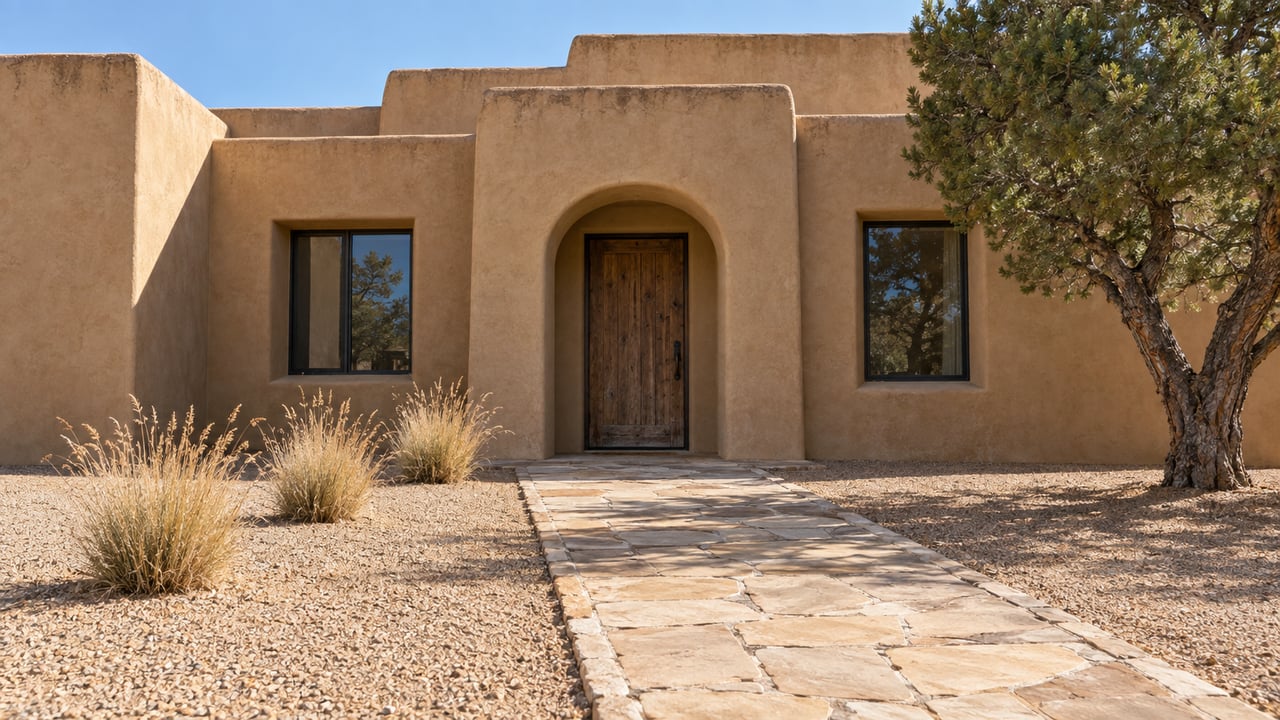
Search "La Tierra Santa Fe" on any portal and you get one median, one map pin, one story. The story is wrong in a useful way. La Tierra and La Tierra Nueva sit shoulder to shoulder off Highway 599, share a cattle-country origin, and get lumped together in every trailing-twelve-month roll-up. They are two different markets with two different covenant regimes, two different price ladders, and two different sets of surprises at inspection. If you are shopping acreage northwest of the Plaza, the difference between them is the difference between the house you write an offer on and the house you back out of after the well test.
Here is the thesis, up front. The trailing-twelve-month median in the La Tierra area is $1,517,000, up roughly 15% year over year, at a moment when Santa Fe single-family sales fell 11.4% in Q1 2026 and days on market stretched from 56 to 87. Acreage buyers are treating these two neighborhoods as a defensive asset while the rest of the county cools. The reason is not mystical. It is the covenant, the water, and the trail access. And it does not apply evenly across both communities.
Start With the Inspection, Not the Listing Photos
Every acreage transaction in La Tierra and La Tierra Nueva has three friction points that never appear in the MLS remarks.
Private wells and septic. Both communities run on private wells and septic systems rather than city utilities. That is not a footnote. It is a due-diligence sequence: flow-rate test, water-quality panel, septic scope, and a review of the well log against county records. Outlying Santa Fe neighborhoods routinely surface issues here that would never appear inside the city meter grid.
Shared driveways and arroyo crossings. Many of the elevated view lots, particularly along Estrada Calabasa, are accessed by shared driveways that cross arroyos. Read the easement before you read the appraisal. Maintenance responsibility, culvert condition, and monsoon-season washouts are all negotiable, and all worth negotiating.
HOA-approved home plans. In La Tierra Nueva especially, you are buying into a design review process. Some sellers market lots with "HOA-approved home plan available," which sounds like a convenience and can be one, but the plan is only as useful as its fit with your build program. A plan modification still runs the review gauntlet.
Get these three items on the table before you talk price. They are what separates the buyer who closes from the buyer who walks in month three.
Two Communities, One Portal Pin
The portals show one neighborhood. Here is the difference that actually matters at the offer stage.
|
La Tierra |
La Tierra Nueva |
| Started |
1975 |
1980 |
| Gating |
Open access |
Guard-gated |
| Typical lot size |
5–20+ acres |
1 to 10+ acres, many multi-acre |
| Home count |
Larger, more established |
About 56 built, roughly 21 lots remaining as of recent counts |
| Trail network |
Extensive on-neighborhood system |
Amenity access plus connections |
| Amenities |
Trail network, equestrian facilities |
Private tennis/pickleball court, adjacency to over 60,000 acres of BLM land |
| Covenants |
Established, allow horses |
Stricter design review, guest houses permitted, horses welcome |
Both communities share Sangre de Cristo sunrise and Jemez sunset views, and both sit roughly 15 to 20 minutes from the Plaza and 15 to 18 minutes from the Santa Fe Regional Airport.
The consequential distinction is the gate. La Tierra Nueva's guard-gated entry, tighter design review, and finite remaining lot inventory produce a supply curve that behaves differently from La Tierra's larger, more elastic inventory of older custom homes on bigger parcels. When acreage demand strengthens, La Tierra Nueva's scarcity compounds faster.
"I developed La Tierra starting in 1975, then came La Tierra Nueva, then Salva Tierra, then Tierra de Oso."
That is Bob Weil, quoted in the Santa Fe New Mexican, describing the sequence of subdivisions carved out of a 31,000-acre former Frank Bond ranch that Zannie Garcia bought in 1960. The water-rights piece is the part most buyers never learn: Weil traded PNM a pipeline right-of-way for water rights that would eventually serve more than 3,000 homes. That transaction is why the community exists at the density it does, and why streets carry names like Longhorn, Shorthorn, Brahma, Hereford, Chisholm Trail, and Goodnight Trail.
What the $1.517M Median Actually Represents
A single median across acreage neighborhoods is almost always misleading, and here it is misleading in a specific way. La Tierra pricing is bimodal.
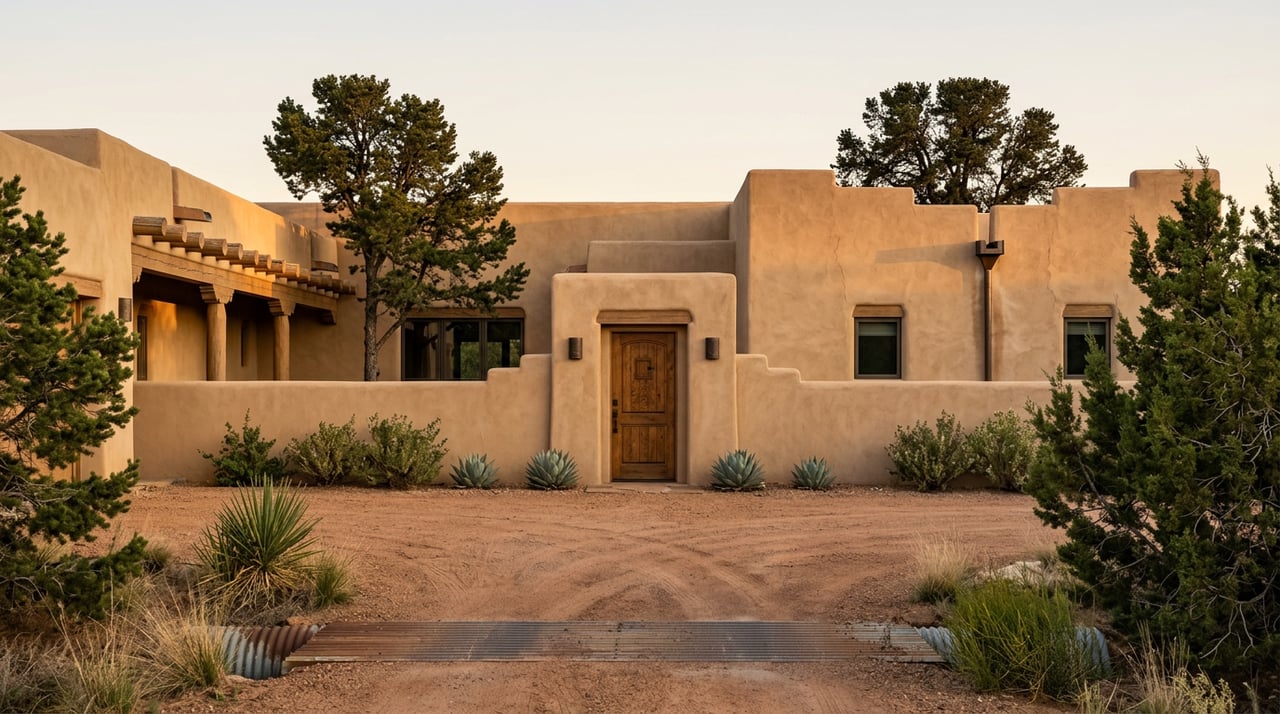
At the low end, undeveloped lots have historically been available starting near $160,000, with current active view lots in the 10 to 14+ acre range trading well above that. At the top, one 25+ acre La Tierra Nueva estate known as "The Dusty Boot," a Stephen Samuelson Studio double-adobe once featured in the Wall Street Journal, ran through a luxury auction in July 2026 with starting bids expected between $3 million and $4 million.
The median falls between those poles, but the mode does not. Recent turnkey custom homes in the 5,000 to 8,000 square-foot range are trading in the $2 million to $4 million band. Smaller residences and older builds still transact in the mid-seven figures. A buyer who anchors on $1.5 million will find a lot, not a house, at that number more often than a broker cold call would suggest.
Per-acre math is the other place the median lies. On a 3-acre parcel, the land is roughly 30% of the deal. On a 15-acre parcel, the land can be under 15%, because construction, views, and covenants carry the price. That inversion is why oversized view parcels look expensive on a total-price basis and cheap on a per-acre basis. It is also why land buyers and house buyers should not be reading the same comps.
Why Acreage Diverged From the Broader County
Countywide, Q1 2026 was soft. KSFR's April interview with Joshua Maes, the 2026 Santa Fe Realtor of the Year, described a "surprisingly stable" market where turn-key homes moved and everything else waited. Single-family sales fell 11.4% year over year. Days on market climbed to 87 from 56. The Santa Fe median sat at $625,000 against a national median around $398,000.
Against that backdrop, La Tierra's trailing-twelve-month median moving up 15% is not a rounding error. It is a signal about what a specific buyer wants right now: acreage, privacy, view corridors, and a covenant that protects both. That buyer is not comparing La Tierra to a townhome near the Railyard. That buyer is comparing La Tierra to Tesuque, to Las Campanas, to Tano Road, and often to a second home in another state. Inventory in that comp set is genuinely scarce, which is why the segment held.
The friction cuts the other way for sellers. In a balanced-to-softer market, buyers underwrite every well log and every easement more carefully. A property that would have closed on charm in 2021 now closes on documentation.
The Names Worth Knowing Before You Tour
Local knowledge in this market is largely a matter of knowing who built what and which architects hold up over time. On tours you will encounter homes by Hoopes Architects, contemporary work with vigas, stone fireplaces, and Lutron systems. Design-build proposals from Palo Santo Designs are being marketed with view lots as a "skip the design process" package. Older La Tierra Nueva compounds by Lila DeWindt carry mature landscaping and vegetable and perennial gardens that new construction cannot replicate for a decade. The Samuelson-designed adobe compounds anchor the top of the market.
For equestrian buyers, the region's top-rated equine hospital sits on Bonanza Creek Road, and both communities connect into regional trail systems maintained in part through the Santa Fe Conservation Trust. The Club at Las Campanas is 8 to 15 minutes away depending on the lot, which matters more for golf and dining access than most buyers admit up front.
FAQ
Is La Tierra Nueva actually gated, or is that marketing?
It is guard-gated, with underground utilities, a private tennis and pickleball court, and access to adjacent BLM land measured in the tens of thousands of acres. La Tierra itself is not gated.
Can I keep horses on either side?
Yes, both communities allow horses under their covenants. The trail infrastructure is denser on the La Tierra side.
What should I ask a seller before I write an offer?
Ask for the well log, the most recent water-quality and flow-rate test, the septic service history, the shared driveway easement, and the HOA design review file if the home was built or renovated under current covenants.
Talk Through Your Shortlist
Acreage decisions do not reward speed. They reward reading the easement, the well log, and the covenant before you walk the lot a second time. If you are weighing La Tierra against La Tierra Nueva, or either of them against Tesuque, Tano Road, or Las Campanas, Leland Titus can walk you through comparable trades, current inventory, and the diligence sequence that actually protects the deal. Search Homes and start a conversation whenever you are ready.