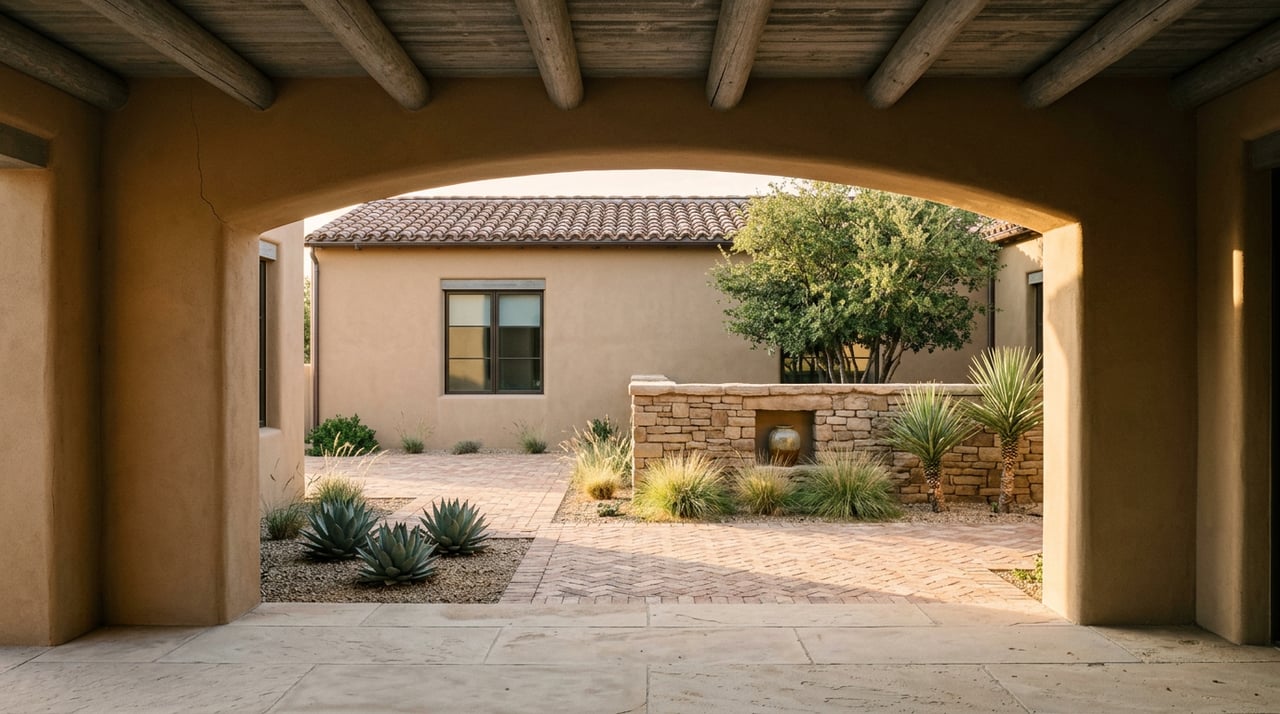
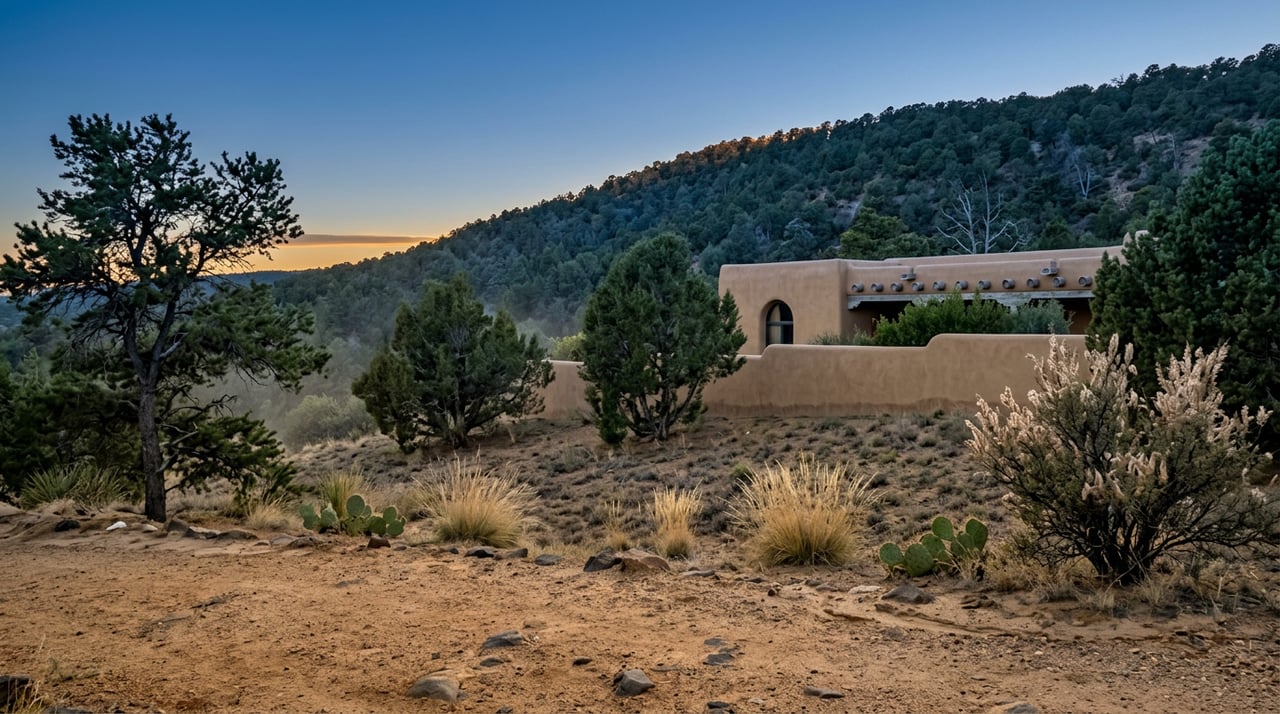
In 2023, two Eldorado property owners installed water-catching cisterns on their property and got a very Santa Fe kind of problem in return. The Eldorado Community Improvement Association encourages cisterns. The homeowners association's own conservation guidance pushes residents toward rain barrels, xeric planting, and reduced water use. But the cisterns went in without a design review, and in a covenant-controlled community, "the association loves this idea" and "the association approved this specific installation" are two different sentences. ECIA board president Carol Sanguinetti addressed the situation publicly in the Santa Fe New Mexican, explaining that any permanently built item in Eldorado, sheds, fences, solar arrays, and yes, cisterns, requires Architecture Committee approval before it goes in the ground. As of that letter, the board hadn't taken enforcement action. It was hoping the owners would either screen the cisterns to meet the guidelines or propose a variance that respected the intent of the rules.
That story is small. It is also the whole pattern. Eldorado's covenants get discussed most often as a style question: stucco tones, roof pitch, whether a home reads as Territorial or Pueblo Revival. The style conversation is real, but it isn't where the risk lives. The risk lives in a quieter fact about how the system works: the Architecture Committee reviews projects when owners bring them forward, not on a rolling audit of what's already standing on a lot. A shed, a screened patio, or a water cistern can sit on a property for years, fully visible, fully in use, and never get tested against the covenants until something forces the question, a neighbor complaint, a new survey, or a sale.
The Committee Meets Every Other Tuesday, and It Reviews Almost Everything Case by Case
The Architecture Committee isn't an abstraction. It's a small group of named volunteers who meet at 5:30 PM on the second and fourth Tuesday of each month, currently over Zoom, working through a submission queue that ranges from fence relocations to full additions. The committee's current roster includes Casey Cronin, Larry Ward, Gary Moran, Bryan Baldwin, and Mike Beard, with James Herbert Williams serving as board liaison, Ken Howard as alternate liaison, and Mark Young and Niamh Walsh handling staff liaison duties.
What actually crosses their desk shows how granular the oversight gets. Committee meeting minutes from a single 2022 session included a fence relocation at 109 Monte Alto Road, approved with no stipulations beyond a note about wire visibility. A greenhouse and studio addition at 7 Casa Del Oro Lane got approved on the condition that the new stucco match the existing color. A second-story bedroom addition at 24 Cerrado Loop needed a height variance, which the committee recommended because the original home had already been approved at 19 feet 4 inches and the addition added no new height, only square footage. An RV screening fence at 9 Recado Road required a setback variance, which the committee supported partly because the neighboring owner at 11 Recado Road was on record in favor of it.
None of that is unusual. It's the normal texture of how Eldorado handles exterior change: individualized review, site visits when needed, and approval conditions tied to the specific project and the specific neighbors. Which means the paperwork proving a past project was done right isn't a form buried in a county archive. It's a decision made by named people on a particular Tuesday, and if that decision was never sought, there's no file to find.
What the Guidelines Actually Require Written Approval For
The current architectural guidelines, last revised in January 2026, are far more specific than "keep it Santa Fe style." A sample of what needs sign-off before it goes up:
| Feature |
The rule |
Approval needed |
| Setbacks |
50 ft front, 20 ft rear, 10 ft from drainage easements or 20 ft side, whichever is greater |
Yes, variances available through the board |
| Accessory structures |
No more than 3 per lot, capped at 384 sq ft combined |
Yes |
| Stucco color |
Max 2 compliant colors per home |
Yes, for non-listed colors |
| Tile or metal roofing |
Must carry a light reflective value of 40 or less |
Yes |
| Satellite dishes |
Only 1 per lot, screened to minimize visibility |
Yes |
| Signs |
Prior written approval required, with limited exemptions |
Yes |
| Berms or vegetation used for screening |
Must preserve the natural landscape appearance |
Yes |
Every row on that list describes a project a homeowner might reasonably do without thinking twice: repaint the stucco, add a shed for the mower, put up an RV screen. In Eldorado, each one is a covenant question first and a construction question second.
Why the Cistern Case Is the Rule, Not the Exception
The Bedner and Lowe cisterns weren't installed out of spite for the rules. They were installed in the spirit of what the association says it wants: less water use, more conservation, a smaller footprint on a shared aquifer. That's exactly why the story matters. It shows that good intentions and covenant compliance aren't the same test. An improvement can be exactly what the community values and still be procedurally out of compliance, sitting quietly on a property until a sale, a survey, or a neighbor's question puts it in front of the committee.
For a buyer, that means the visual condition of a home tells you almost nothing about its paper trail. For a seller, it means the safest assumption is that any exterior change made without a submitted plan is an open question, not a settled one, no matter how long it's been standing or how sensible it looked at the time.
What Actually Shows Up in the Sale Documents
Eldorado listings on the local MLS commonly bundle a standard packet: floorplan, home inspection report, plat, septic inspection, seller's property disclosure, and survey. That's a reasonably thorough set for evaluating the physical condition of a house. It says nothing about whether the studio addition, the RV enclosure, or the greenhouse carries a written Architecture Committee approval letter. Covenant compliance simply isn't one of the documents in that packet, because it isn't tracked the same way a septic permit or a survey is.
It gets thinner at the edges of the market. Vacant land and spec-lot sales in Eldorado sometimes close with no seller's disclosure at all, because the seller never occupied the property and has nothing to disclose from lived experience. That's a legitimate reason, but it also means the burden of confirming water availability, prior approvals, and site conditions shifts entirely to the buyer's own due diligence, since there's no seller history to lean on.
The Second System People Forget: Septic Isn't the District's Problem
Eldorado runs on two separate infrastructure systems that don't share a file cabinet. The Eldorado Area Water & Sanitation District supplies water to nearly 3,000 customer accounts and roughly 6,500 people across about 20 square miles, and it owns the wells, pumping stations, storage tanks, and distribution lines that make that possible. Wastewater is a different story entirely. The district is explicit that homes and businesses in the service area rely on private septic systems, and that septic maintenance is the homeowner's responsibility, not the district's. A clean bill of health on the water side tells you nothing about tank age, leach field condition, or whether the system has been pumped on the recommended 1 to 3 year cycle.
Put the two threads together and the diligence list for Eldorado looks less like a single checklist and more like two parallel ones: the covenant history for whatever's been built on the lot, and the physical condition of a septic system that operates entirely outside the water district's oversight. A buyer who only checks one of them has only done half the work.
What the Membership Actually Costs Now
None of this happens for free. The ECIA's own January 2026 newsletter set the 2026 annual assessment at $701, billed quarterly at $175.25 due at the end of January, April, July, and October. That figure has climbed a long way from the $240 annual assessment the association's general manager was quoting prospective buyers around the 2008 budget cycle, a period when Eldorado's dues stayed comparatively low in large part because Santa Fe County, not the association, owns and maintains most of the roads inside the community. That structural advantage kept costs down for years. It hasn't kept them flat.
None of that assessment covers the cost of fixing a covenant gap. A retroactive variance request, a required screening fence, or a stucco color correction is a separate expense on top of the annual dues, and it runs on the committee's own biweekly meeting schedule rather than a fixed turnaround time.
The Practical Version
If you're selling in Eldorado, the useful question isn't "does this match the style guide." It's "can I produce a written approval for everything that isn't original to the house." If you're buying, ask the same question about what you're inheriting, and separately ask when the septic system was last inspected, since that clock runs independently of anything the Architecture Committee tracks.
FAQ
Does an unapproved addition follow the house or the seller?
Approval history is tied to the lot's building file, not to whichever owner happened to build the addition. That's why a buyer inherits the question along with the property, whether or not the seller ever thought to ask it themselves.
Is Eldorado on city sewer?
No. Water comes through the Eldorado Area Water & Sanitation District's wells and distribution system, but wastewater runs through private, individually owned septic systems that the district does not manage.
How often should a septic system in Eldorado be inspected?
The water district's own guidance points to an inspection every 1 to 3 years, with pumping scheduled as needed based on that inspection.
Whether you're weighing an offer on a lot with a few decades of additions behind it or getting ready to list a home you've lived in for years, the covenant history and the septic history are two separate conversations worth having before anything goes under contract. Leland Titus works Eldorado regularly and can walk through what a specific property's paper trail actually looks like. Search Homes to see what's currently available in the neighborhood.